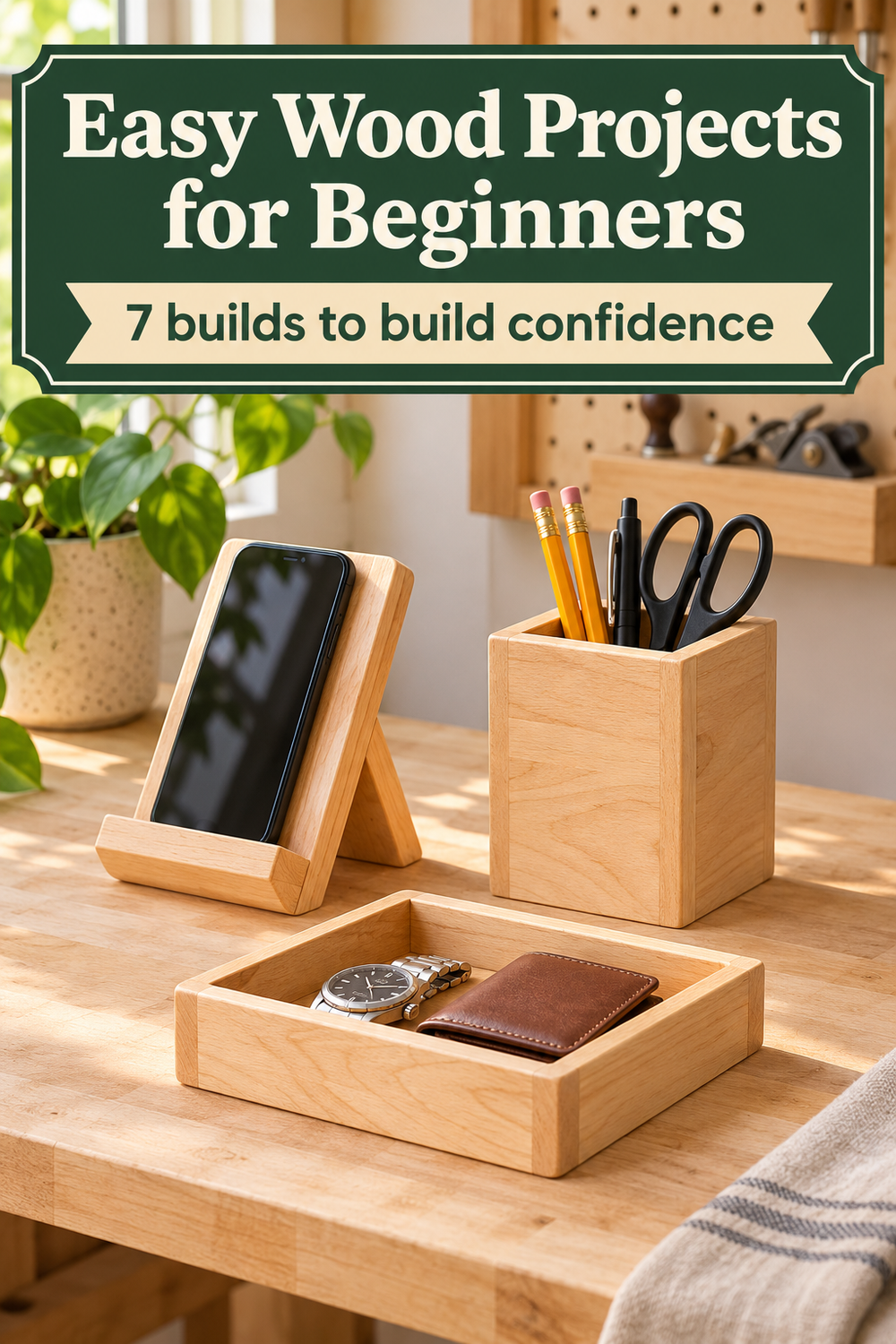
7 Easy Wood Projects for Beginners to Build Confidence
Easy wood projects for beginners are easiest to finish when they solve a problem you already have. A tray gives your keys a home. A bookend keeps paperbacks upright. Pick one job, measure the spot where the finished piece will go, and write down its maximum footprint. That gives you a way to choose between projects before you buy a board.
Seven easy wood projects for beginners
1. A shallow tray for keys
Start with a flat base and four low sides. Set your keys and wallet on a piece of paper and draw around the space they occupy to estimate the inside dimensions. The sides take up room, so sketch the tray from above and label both the inside and outside measurements. Dry-fit the pieces and make sure the objects fit before you fasten the sides.
*Affiliate disclosure. I may earn a commission if you make a purchase through my links.*
If you want another design to compare, browse the 50 Free Wood Plans. For a first tray, look for a drawing that shows how the corners meet and a materials list that specifies the base thickness.
2. A pair of paperback bookends
Each bookend can start with an upright and a base. Put the base beneath the books so their weight helps hold it in place. Measure the height of the books you use most often and choose an upright that supports them without hitting the shelf above. Build one bookend first so you can try it on the shelf before duplicating it.
3. A wooden recipe card holder
A holder can be as simple as a base with two strips spaced to cradle a card. Test the spacing with the thickest card you use, including any sleeve. Set the holder where you plan to use it and check whether you can read the card while standing. Set the strips in place temporarily first so you can adjust the angle.
4. A desktop pencil caddy
Make a small open box with a broad base. Put your longest pencil in a cardboard mock-up to decide how high the walls should be. If the box is too deep, short pencils disappear. If it is too narrow, loading it unevenly may make it tip. Use the mock-up to settle both measurements before cutting wood.
5. A set of wooden coasters
Cut or select four matching blanks. Group them by thickness first so the stack sits neatly. Sand a test piece and set an empty glass on it to check for rocking. This is a good project for practicing repeated measurements. Mark all four pieces from the same reference measurement so a small error on one piece does not carry over to the next.
If you prefer to start with a measured drawing, see the 50 Free Wood Plans. For a set, check whether the drawing gives you dimensions for one finished piece and enough information to estimate material for the full batch.
6. A freestanding phone rest
Measure the phone with its case on. Test the resting angle with a cardboard mock-up, then check whether the lip obscures the bottom of the screen. If you want to charge the phone upright, leave room for the plug and cable bend. A base that extends behind the phone gives you more room to adjust the angle.
7. A shallow box for scrap wood
Choose a footprint based on the longest offcuts you actually save. Make the short sides low enough that you can see what is inside, or sort small strips into a removable divider. Dry-fit the bottom and sides with one of your larger scraps in place. If it catches on a corner every time you reach for it, adjust the dimensions while the pieces are still loose.
Choose a project you’ll use this week
The best easy wood projects for beginners have a clear finish line. Pick one above, list its parts, and mark the one step you want to practice, such as cutting matching pieces or assembling a square corner. Set everything out before you start so you can spot a missing part or tool.
Find Out More
If you want to compare more designs before choosing your first build, explore the 50 Free Wood Plans.